


Inside the New Power Structure: How Trump, Rubio, and Noem Are Reshaping American Foreign and Border Policy
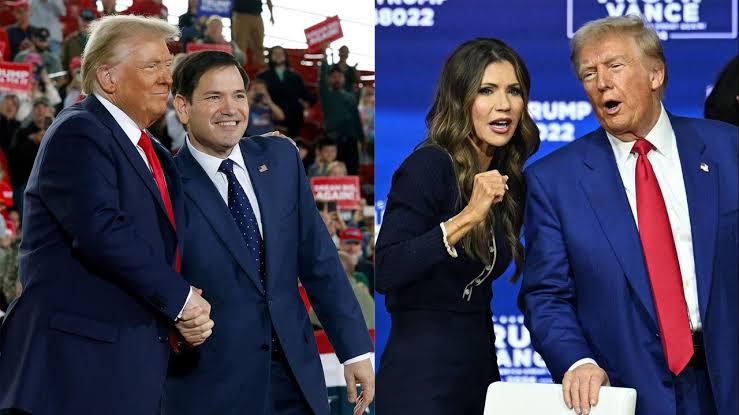
The first months of any administration reveal the actual architecture of power behind the elected official at its center. Titles matter less than access. Cabinet appointments matter less than who is genuinely listened to in the room where decisions are made. By those measures, the current administration has developed a clear and deliberate structure in the two policy areas it has prioritized most aggressively: foreign affairs and border security.
Secretary of State Marco Rubio and Secretary of Homeland Security Kristi Noem occupy the two cabinet positions most central to that agenda. How they have operated within it, and how their approaches have shaped the administration's early record, reveals a great deal about where American policy is heading and the domestic and international consequences that are beginning to accumulate.
Rubio at State: The Realist Convert
Marco Rubio came to the Secretary of State role carrying the ideological history of a senator who spent his early career as a prominent voice for democracy promotion and democratic solidarity, particularly in Latin America. His rhetoric on Venezuela, Cuba, and Nicaragua was among the sharpest in the Senate. His confirmation represented, for many foreign policy observers, an open question: would the secretary follow the president's more transactional instincts, or would he try to embed a values-based framework within them?
The answer, based on the first months of his tenure, appears to be a pragmatic synthesis weighted heavily toward transactionalism. Rubio has been an active secretary in the traditional sense — conducting shuttle diplomacy, maintaining communication with counterparts across multiple regions, and demonstrating a command of the substantive detail that the role requires. His relationship with President Trump appears to be functional and, by most accounts, genuinely close — a departure from the friction that characterized some previous secretaries' relationships with the same principal.
On Russia-Ukraine, Rubio has been more publicly engaged than his predecessor in seeking to frame a negotiated end to the conflict. His approach has prioritized what he describes as a realistic assessment of what is achievable over what is desirable, a formulation that has frustrated allies who believe the current moment requires stronger signals of Western resolve. European counterparts have found him reliable in private communication but have expressed concern through diplomatic channels about whether the American commitment to Ukrainian sovereignty is as firm as formal statements suggest.
In the Western Hemisphere — the region Rubio knows best — his approach has been more assertive. Pressure on Venezuela and Cuba has intensified through targeted sanctions. Engagement with Central American governments on migration has been structured around conditionality, with cooperation on border enforcement as the central ask in exchange for economic partnership. Whether those leveraging efforts produce durable results or simply reroute migration flows remains to be seen, but the strategic framework is more coherent than the improvised approaches that characterized much of recent bilateral engagement in the region.
The question that will define Rubio's tenure is whether he can sustain influence over policy that is ultimately made by a principal whose instincts are quite different from the traditional statecraft framework in which Rubio was trained. Secretaries who have tried to steer rather than implement have sometimes found themselves marginalized. Those who have implemented without pushing back have sometimes found themselves presiding over consequences they could not prevent.
Noem at DHS: Enforcement as Strategy
Kristi Noem's appointment to lead the Department of Homeland Security followed a national political career that moved from the South Dakota governorship to the center of conservative media attention. Her tenure at DHS has been shaped by two simultaneous demands: managing the operational reality of a department that is enormous, complex, and historically difficult to administer, and serving as the public face of an immigration enforcement posture that is among the most aggressive in recent American history.
The enforcement numbers have been the administration's most cited metric of success in this area. Border encounters have fallen significantly from recent peaks, a decline that the administration attributes to the combination of policy changes, enforcement operations, and diplomatic pressure on transit countries. Immigration advocates and some independent analysts argue that the numbers reflect seasonal patterns and the deterrent effect of rhetoric rather than the structural changes the administration claims, and that the human costs of the enforcement posture — including the disruption of asylum processes that have legal standing — are being undercounted in the official accounting.
Noem has been most visible in the administration's operations targeting undocumented immigrants in the interior of the country. These operations, significantly broader in scope than anything attempted in recent previous administrations, have proceeded through ICE with an intensity that has generated legal challenges, community disruption in cities with large immigrant populations, and diplomatic friction with countries whose nationals are being detained and deported at increased rates. Several federal judges have placed limits on specific aspects of these operations, creating an ongoing tension between executive enforcement authority and judicial oversight that shows no signs of resolution.
The department's capacity has been tested by the pace and scale of what is being asked of it. DHS encompasses agencies with very different institutional cultures and operational capabilities — Customs and Border Protection, Immigration and Customs Enforcement, the Secret Service, FEMA, the Transportation Security Administration, among others. Managing that enterprise while also serving as a high-visibility political advocate for the administration's signature issue is a demanding dual role, and the strains have occasionally shown in the form of operational errors and communication inconsistencies that have required public correction.
The Convergence
What makes the Rubio-Noem combination particularly significant is where their portfolios overlap: the diplomatic framework that Rubio is building for the Western Hemisphere and the enforcement apparatus that Noem is managing are, in the administration's conception, complementary instruments of a single strategy. The argument is that credible enforcement creates the leverage for diplomatic engagement, and diplomatic agreements on migration management reduce the operational burden on enforcement. It is a coherent theory, and there is historical precedent for elements of it working.
Whether the theory holds in practice depends on factors that neither cabinet member fully controls: whether transit countries find the American offer genuinely more attractive than resistance, whether enforcement operations can be sustained at current intensity without significant legal reversal, and whether the populations most affected by the combination of diplomatic pressure and enforcement escalation find alternative paths or simply absorb the disruption.
What is clear is that the administration has made its choices visible. The approach to border security and foreign policy is being implemented at scale, with explicit accountability, and with a political commitment to defending the choices that have been made. The consequences — economic, diplomatic, humanitarian, and legal — are still accumulating. How they are assessed, both at home and abroad, will be one of the central judgments that defines this period in American governance.
The Americas Press will continue to track and report these developments as they unfold.


